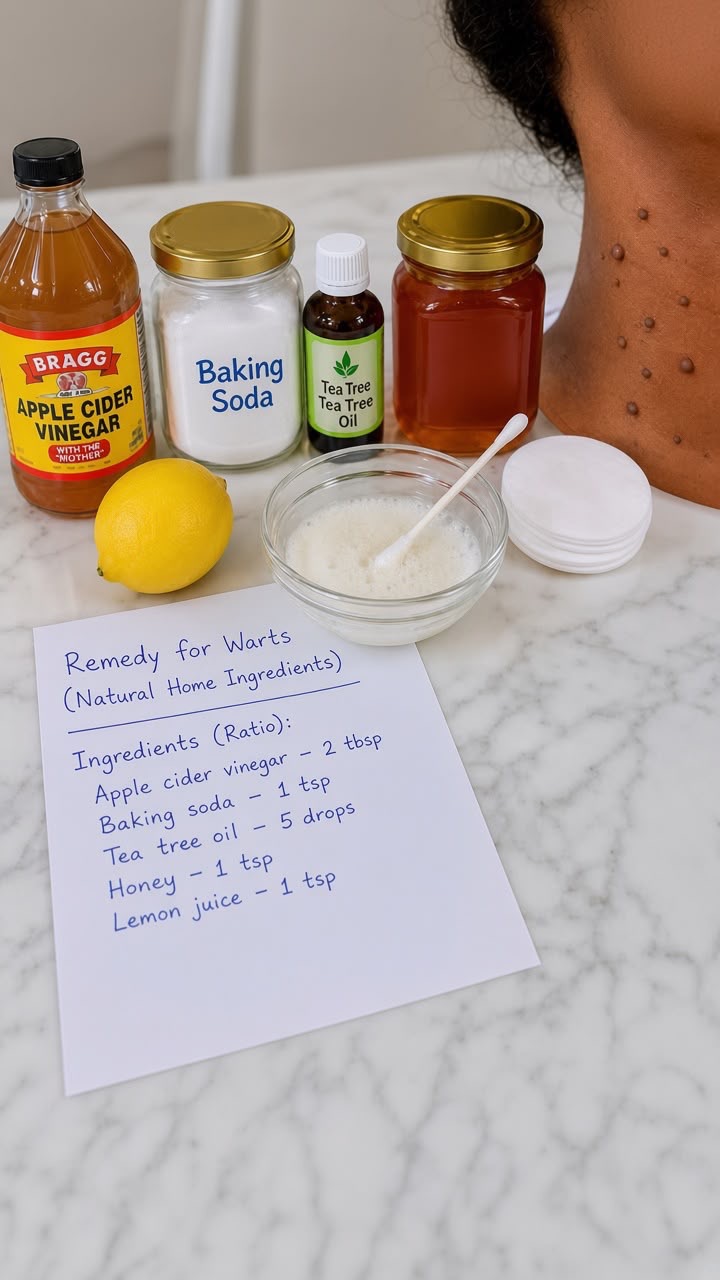
Natural Home Remedy for Warts
Introduction
Warts are common skin growths caused by certain types of human papillomavirus (HPV). Although many warts eventually disappear on their own, they can sometimes be stubborn.
The homemade mixture below combines apple cider vinegar, honey, lemon juice, baking soda, and tea tree oil. However, there is not strong clinical evidence that this specific combination removes warts, and some ingredients may cause irritation or burns. For that reason, it should not be presented as a proven wart treatment.
Recipe Overview
| Feature | Details |
| Prep Time | 5 minutes |
| Application Time | 5–10 minutes initially |
| Yield | 1 treatment |
| Category | DIY Skincare / Home Remedy |
| Method | Short-contact topical application |
Ingredients
| Ingredient | Amount |
| Apple cider vinegar | 2 tablespoons |
| Baking soda | 1 teaspoon |
| Honey | 1 teaspoon |
| Lemon juice | 1 teaspoon |
| Tea tree essential oil | 5 drops |
Step-by-Step Instructions
Prepare the mixture: Place the baking soda in a small glass bowl.
Add the apple cider vinegar: Slowly add the vinegar. The ingredients will fizz as they react. Allow the bubbling to settle.
Add the remaining ingredients: Stir in the honey, lemon juice, and tea tree oil until combined.
Patch test first: Apply a tiny amount to a small area of unaffected skin and wait to see whether irritation occurs.
Apply cautiously: If there is no reaction, use a clean cotton swab to place a very small amount on the wart only. Avoid surrounding healthy skin as much as possible.
Keep the contact time short: Leave it on for about 5–10 minutes initially.
Rinse thoroughly: Remove the mixture with lukewarm water.
Moisturize the surrounding skin: Apply a gentle, fragrance-free moisturizer if the surrounding skin feels dry.
Important Safety Tips
Do not apply this mixture to a wart that is bleeding, infected, ulcerated, or otherwise damaged.
Do not use it around the eyes, mouth, genitals, or other sensitive areas.
Stop immediately if you experience significant burning, swelling, blistering, or severe redness.
Do not cover the area overnight with this acidic mixture.
Tea tree oil can cause skin irritation or allergic reactions, particularly when used undiluted or at excessive concentrations.
Ingredient Alternatives
You can omit the lemon juice if your skin is sensitive.
However, replacing apple cider vinegar with white vinegar does not necessarily make the treatment safer. Both are acidic and can irritate the skin.
Manuka honey can be used as a cosmetic ingredient, but there is not enough evidence to say that adding it makes this mixture an effective wart treatment.
Storage
For hygiene and safety, prepare only enough for one application.
Because this homemade mixture contains fresh ingredients and has no preservative system, it is preferable to discard leftovers rather than store them for several days.
Do not reheat or freeze the preparation.
Common Mistakes to Avoid
Applying too much: More product does not mean better results and may increase irritation.
Treating healthy skin: Keep the mixture limited to the affected area.
Using it every day: Daily application can damage surrounding skin, particularly because the mixture contains acidic ingredients.
Ignoring persistent warts: A growth that changes, bleeds, becomes painful, or does not look like a typical wart should be evaluated by a healthcare professional.
Nutritional Information
Because this is intended for topical use, nutritional values such as calories are not relevant.
| Metric | Details |
| Calories | Not applicable for topical use |
Frequently Asked Questions
Can I apply this remedy every day?
It is better not to recommend daily application of this acidic mixture. Repeated exposure can irritate or damage the skin.
Can I use Manuka honey instead?
You can use Manuka honey as a cosmetic ingredient, but it should not be considered a proven wart treatment.
Is apple cider vinegar proven to remove warts?
There is insufficient high-quality clinical evidence to establish this homemade mixture as a reliable wart treatment. Apple cider vinegar is acidic and can cause skin irritation or burns.
What treatments have better evidence?
For common warts, salicylic acid preparations are among the commonly used over-the-counter options. A healthcare professional can also discuss treatments such as cryotherapy when appropriate.
When should I see a doctor or dermatologist?
Seek professional advice if you are unsure whether the growth is actually a wart, if it is painful or bleeding, if it changes appearance, if you have many warts, or if an over-the-counter treatment does not work.
Conclusion
DIY skincare remedies can be appealing because they use familiar household ingredients, but natural ingredients are not automatically safe or effective for treating warts.
For a suspected wart, evidence-based treatments are generally preferable to acidic homemade mixtures. If you decide to experiment with any topical ingredient, protect the surrounding skin and stop immediately if irritation develops.
Warts are common skin growths caused by certain types of human papillomavirus (HPV). Although many warts eventually disappear on their own, they can sometimes be stubborn.
The homemade mixture below combines apple cider vinegar, honey, lemon juice, baking soda, and tea tree oil. However, there is not strong clinical evidence that this specific combination removes warts, and some ingredients may cause irritation or burns. For that reason, it should not be presented as a proven wart treatment.
Recipe Overview
| Feature | Details |
| Prep Time | 5 minutes |
| Application Time | 5–10 minutes initially |
| Yield | 1 treatment |
| Category | DIY Skincare / Home Remedy |
| Method | Short-contact topical application |
Ingredients
| Ingredient | Amount |
| Apple cider vinegar | 2 tablespoons |
| Baking soda | 1 teaspoon |
| Honey | 1 teaspoon |
| Lemon juice | 1 teaspoon |
| Tea tree essential oil | 5 drops |
Step-by-Step Instructions
Prepare the mixture: Place the baking soda in a small glass bowl.
Add the apple cider vinegar: Slowly add the vinegar. The ingredients will fizz as they react. Allow the bubbling to settle.
Add the remaining ingredients: Stir in the honey, lemon juice, and tea tree oil until combined.
Patch test first: Apply a tiny amount to a small area of unaffected skin and wait to see whether irritation occurs.
Apply cautiously: If there is no reaction, use a clean cotton swab to place a very small amount on the wart only. Avoid surrounding healthy skin as much as possible.
Keep the contact time short: Leave it on for about 5–10 minutes initially.
Rinse thoroughly: Remove the mixture with lukewarm water.
Moisturize the surrounding skin: Apply a gentle, fragrance-free moisturizer if the surrounding skin feels dry.
Important Safety Tips
Do not apply this mixture to a wart that is bleeding, infected, ulcerated, or otherwise damaged.
Do not use it around the eyes, mouth, genitals, or other sensitive areas.
Stop immediately if you experience significant burning, swelling, blistering, or severe redness.
Do not cover the area overnight with this acidic mixture.
Tea tree oil can cause skin irritation or allergic reactions, particularly when used undiluted or at excessive concentrations.
Ingredient Alternatives
You can omit the lemon juice if your skin is sensitive.
However, replacing apple cider vinegar with white vinegar does not necessarily make the treatment safer. Both are acidic and can irritate the skin.
Manuka honey can be used as a cosmetic ingredient, but there is not enough evidence to say that adding it makes this mixture an effective wart treatment.
Storage
For hygiene and safety, prepare only enough for one application.
Because this homemade mixture contains fresh ingredients and has no preservative system, it is preferable to discard leftovers rather than store them for several days.
Do not reheat or freeze the preparation.
Common Mistakes to Avoid
Applying too much: More product does not mean better results and may increase irritation.
Treating healthy skin: Keep the mixture limited to the affected area.
Using it every day: Daily application can damage surrounding skin, particularly because the mixture contains acidic ingredients.
Ignoring persistent warts: A growth that changes, bleeds, becomes painful, or does not look like a typical wart should be evaluated by a healthcare professional.
Nutritional Information
Because this is intended for topical use, nutritional values such as calories are not relevant.
| Metric | Details |
| Calories | Not applicable for topical use |
Frequently Asked Questions
Can I apply this remedy every day?
It is better not to recommend daily application of this acidic mixture. Repeated exposure can irritate or damage the skin.
Can I use Manuka honey instead?
You can use Manuka honey as a cosmetic ingredient, but it should not be considered a proven wart treatment.
Is apple cider vinegar proven to remove warts?
There is insufficient high-quality clinical evidence to establish this homemade mixture as a reliable wart treatment. Apple cider vinegar is acidic and can cause skin irritation or burns.
What treatments have better evidence?
For common warts, salicylic acid preparations are among the commonly used over-the-counter options. A healthcare professional can also discuss treatments such as cryotherapy when appropriate.
When should I see a doctor or dermatologist?
Seek professional advice if you are unsure whether the growth is actually a wart, if it is painful or bleeding, if it changes appearance, if you have many warts, or if an over-the-counter treatment does not work.
Conclusion
DIY skincare remedies can be appealing because they use familiar household ingredients, but natural ingredients are not automatically safe or effective for treating warts.
For a suspected wart, evidence-based treatments are generally preferable to acidic homemade mixtures. If you decide to experiment with any topical ingredient, protect the surrounding skin and stop immediately if irritation develops.