Introduction
Welcome to a simple DIY skincare recipe made with everyday ingredients.
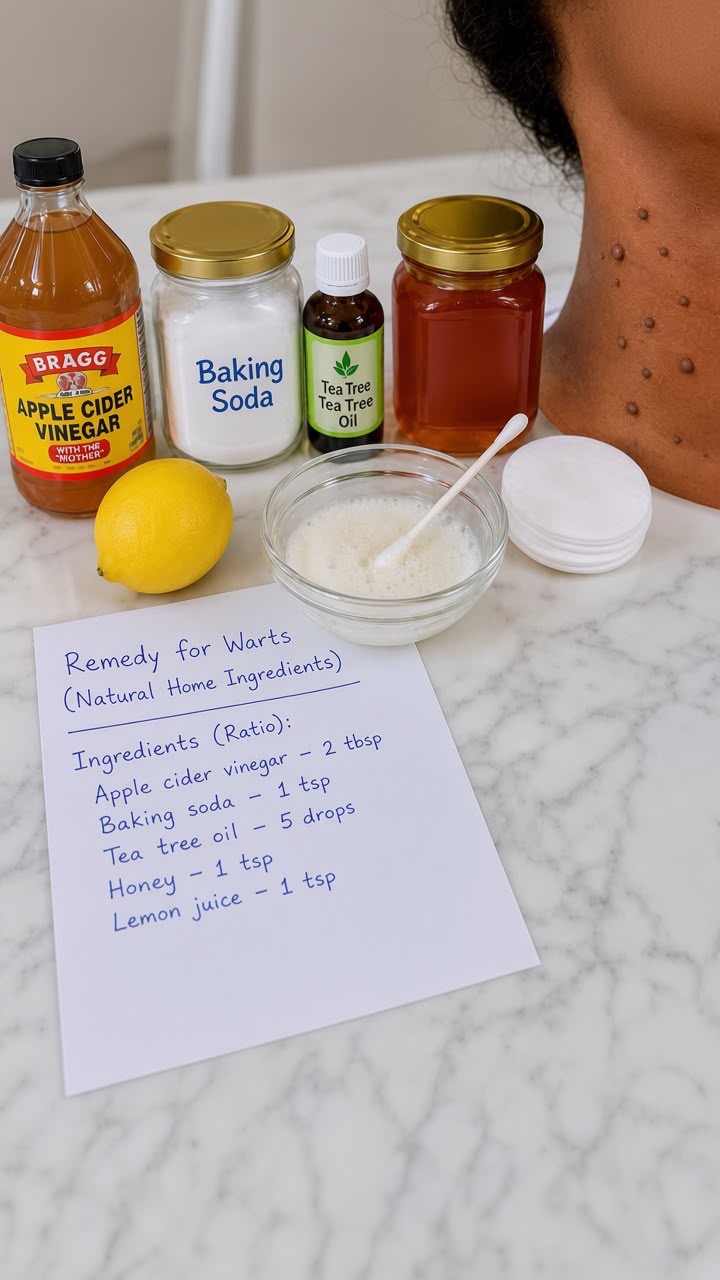
This homemade mixture combines apple cider vinegar, honey, lemon juice, baking soda, and tea tree oil into a targeted topical treatment.
Important: This combination can be irritating because it contains acidic ingredients, baking soda, and essential oil. It is safer to patch-test first and avoid using it on broken, irritated, or sensitive skin.
Recipe Overview
| Prep Time | Yield | Category | Application |
| 5 minutes | 1 small batch | DIY Skincare | Targeted topical use |
Why You’ll Love This Recipe
Uses simple household ingredients.
Takes only a few minutes to prepare.
Designed for targeted rather than full-face application.
Easy to customize for different skin sensitivities.
No complicated skincare equipment is required.
Ingredients
| Ingredient | Quantity | Purpose |
| Apple cider vinegar | 2 tbsp | Acidic base |
| Baking soda | 1 tsp | Cleansing/textural ingredient |
| Honey | 1 tsp | Moisturizing and soothing |
| Fresh lemon juice | 1 tsp | Citrus-based ingredient |
| Tea tree essential oil | 5 drops | Aromatic botanical ingredient |
Step-by-Step Instructions
Prepare your workspace.
Wash your hands and use a clean glass or ceramic bowl and a clean cotton swab.
Combine the baking soda and apple cider vinegar.
Add the baking soda to the bowl, then slowly pour in the apple cider vinegar. The mixture will fizz because of the acid-base reaction. Allow the bubbling to settle.
Add the remaining ingredients.
Stir in the honey and fresh lemon juice until reasonably combined.
Add the tea tree oil.
Add the five drops of tea tree essential oil and mix thoroughly.
Patch-test first.
Before applying it to a larger area, place a very small amount on a discreet area of skin and wait to see whether irritation develops.
Apply sparingly.
If your skin tolerates the patch test, use a clean cotton swab to apply a tiny amount only to the intended area. Avoid the eyes, lips, nostrils, and broken skin.
Rinse if irritation occurs.
If you experience burning, significant redness, swelling, itching, or discomfort, rinse the area thoroughly with cool water and discontinue use.
Best Tips
Use clean utensils and a fresh cotton swab each time to reduce contamination.
Do not apply this mixture immediately after shaving, exfoliating, waxing, or using another potentially irritating skincare product.
Avoid sun exposure after using lemon juice on the skin. Using sunscreen during the day is especially important.
Do not assume that a natural ingredient is automatically gentle or suitable for every skin type.
Best Ingredient Options
Apple Cider Vinegar: Choose plain apple cider vinegar without added fragrance or flavoring.
Honey: Plain honey can be used. There is no need to use expensive specialty honey.
Lemon: Fresh lemon juice can be used, but because citrus may irritate skin and increase photosensitivity, you may prefer to leave it out entirely.
Tea Tree Oil: Use a properly labeled tea tree essential oil and never apply concentrated essential oil directly to the skin.
Safer Variations
For sensitive skin, the simplest variation is to omit the lemon juice and tea tree oil.
For an even gentler DIY approach, skip the vinegar and baking soda and use plain honey as a short-contact mask, provided you know your skin tolerates honey.
You can also choose a fragrance-free commercial moisturizer afterward rather than adding more active ingredients to the skin.
What to Use Afterward
After rinsing the treatment, gently pat your skin dry.
Apply a simple, fragrance-free moisturizer to help maintain the skin barrier.
During the daytime, use broad-spectrum sunscreen, especially if you have used citrus ingredients.
Make-Ahead Instructions
This recipe is best prepared fresh in a very small quantity.
Because it contains fresh lemon juice, honey, water-producing ingredients, and no preservative system, homemade leftovers should not be treated like a commercially preserved skincare product.
Storage
For the safest approach, make only the amount you intend to use immediately and discard leftovers.
Do not store homemade skincare mixtures for several days at room temperature.
Reheating
There is no reason to heat or reheat this treatment.
Use it at room temperature and discard any unused mixture.
Freezing
Freezing is unnecessary and may change the texture and consistency of the ingredients.
Fresh preparation is preferable.
Common Mistakes to Avoid
Using it on damaged skin: Never apply this mixture to cuts, open wounds, sunburn, eczema flares, or severely irritated skin.
Skipping a patch test: Even familiar household ingredients can cause irritation or allergic reactions.
Using too much tea tree oil: Essential oils can irritate or sensitize the skin when used incorrectly.
Leaving it on too long: A stronger or longer application does not necessarily produce better skincare results.
Applying it around the eyes: Keep the mixture well away from the eye area.
Using lemon before sun exposure: Citrus juice can make some people’s skin more sensitive to sunlight.
Expecting instant results: A homemade skincare mixture cannot guarantee treatment of acne, dark spots, infections, or other skin conditions.
Nutrition Estimate
Because this preparation is intended for topical use only, conventional nutrition information is not applicable.
| Nutrient | Amount |
| Calories | Not applicable |
| Protein | Not applicable |
| Carbohydrates | Not applicable |
| Fat | Not applicable |
| Use | Topical only |
Frequently Asked Questions
Can I use this every day?
It is not advisable to automatically use this mixture once or twice daily. The combination may be irritating, particularly with repeated use. Start with a patch test and discontinue it if irritation develops.
Can I use it on my whole face?
No. Because the mixture contains potentially irritating ingredients, targeted application is safer than applying it broadly across the face.
Can I leave out the tea tree oil?
Yes. Omitting tea tree oil is a reasonable option, particularly if you have sensitive skin or have reacted to essential oils before.
Can I leave out the lemon juice?
Yes. This is actually a useful modification because lemon juice can irritate skin and may increase sensitivity to sunlight.
Why does the mixture fizz?
The baking soda reacts chemically with the acidic apple cider vinegar, producing carbon dioxide bubbles.
Can this cure acne or other skin conditions?
It should not be described as a cure. Persistent acne, infections, unusual rashes, or changing skin lesions are better evaluated by a qualified healthcare professional.
Final Thoughts
DIY skincare can be appealing because it is inexpensive and easy to prepare, but natural ingredients can still cause irritation.
If you decide to try this recipe, keep the application minimal, patch-test first, avoid damaged skin, and stop immediately if your skin reacts badly.
For sensitive or problem skin, a simple fragrance-free moisturizer and sunscreen may be a safer everyday skincare routine than using multiple active household ingredients.
⚠️ This recipe may not be suitable for everyone, so it is advisable to consult a doctor.